Dagnall School
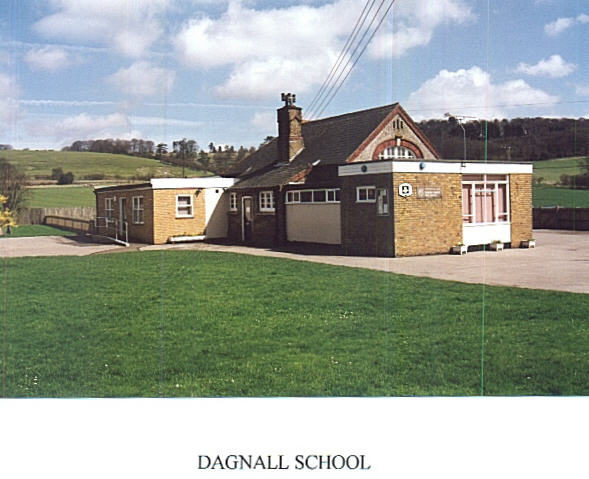
DAGNALL SCHOOL
The sections are extracts from: "A History of Dagnall" by Mr Geoff Spencer
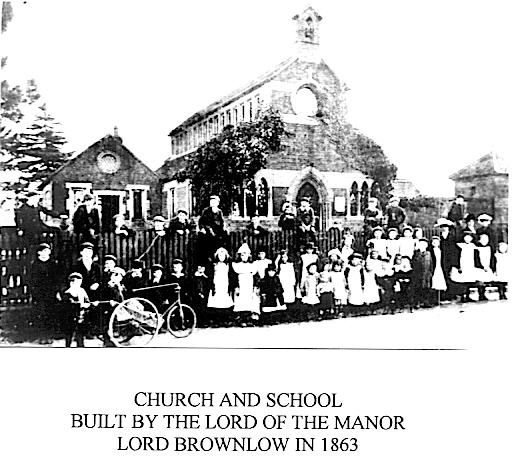
In the latter half of the 19th century, some sections of society were getting increasingly concerned over the lack of education for the children of-the poor.
A variety of private, charity, and church schools were opened to cater for the need, but the level of education provided varied enormously. A system of paying grants to schools out of the county rates was introduced. Every year inspectors visited each school to examine each child in the three primary subjects (i.e. reading, writing and arithmetic), and then a grant per child was paid depending on the results.

The Education Act of 1870 authorised the election of local school boards-to raise rates for the provision of elementary-schools (known as Board Schools) in areas where there was no satisfactory charity or church school. In 1902 the responsibility of these school boards was taken over by the county councils and Local Education Authorities were created.
By this time Dagnall Church School was getting adverse reports. On 15th June 1906 the school received a report from the Education Authority which said:
"I am to call attention to the Official Letters of 21st July 1905 and 10th March 1906 and state that unless H M inspector is more completely satisfied with the quality of education of the older children during the forthcoming school year, it will become necessary for the Board of Education to consider the propriety of removing the school from the list of public elementary schools in receipt of an annual grant."
In 1907 plans were drawn up to build a Council-Board School in Dagnall and in January 1909 the Board School, now known. as Dagnall County First School, was opened.

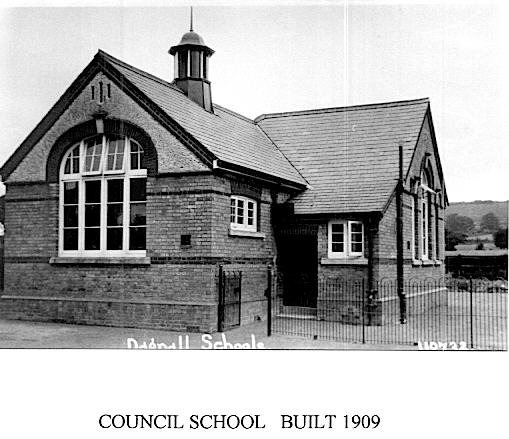
The new school consisted of two rooms. The main room was 24 feet by 18 feet and the infants room 16 feet by 16 feet and was designed to accommodate 40 children in the main room and 24 children in the infants room. The rooms were heated by 2 Tortoise coal and coke enclosed fires and lit by 4 paraffin oil lamps mounted on the walls. The toilets were of the bucket type in the playground. The infants and girls playground was at the front of the school and entered from the centre gate. The boys playground was at the rear and entered by a fenced pathway from the corner gate. The school catered for all the village children from the age of-5 to the school leaving age, which had by now been raised from 10 years to 12 years.
At the outbreak of war in 1914 there were 54 children on the register, rising to 61 in 1915.
Although school attendance had by now been compulsory for some 35 years, attendance was still much affected by inclement weather, illnesses, harvest time etc. Towards the latter part of January 1915 attendance had fallen to 30 due to the heavy snow and the Headmaster received a telegram from the Council instructing him to close the school until 1st February. On re-opening the school on 1st February, the Headmaster sent a telegram to the Council to say only 26 children were present. The following day he received a telegram instructing him to close the school for another week. Again on 7th March 1916 a heavy snowfall reduced the attendance to 36. There were further heavy snowfalls during the month reducing the numbers still further. On 29th March a fierce blizzard made the roads to the village impassable by fallen trees and deep snow drifts. The school was closed.
During the war years the school was also closed at times for what was known as National Work. In June it was closed for 2 weeks to enable the children to work in the hayfields and then again in August/September for the Harvest. It also closed some afternoons for the children to pick Elder Flowers and Plantain Leaves and late September and October it closed most afternoons for the children to go Blackberrying. In 1917 the children gathered 287 pounds of Blackberries.
On 12th November 1918 a note in the school records said that "yesterday morning the Germans signed the Armistice, news arrived in the village during the afternoon. The school therefore closed for the day on the 12th in honour of the event."
Regularly each year on Empire Day (26th May), the normal timetable was suspended and lessons given on the British Empire. Patriotic poems and songs were read and sung and drawings made of the Empire Flower (the Daisy), and the Union Jack in the playground was saluted. On Empire Day 1924 an additional lesson was given on the importance of the Wembley Exhibition entitled "The Birthday Party of the Empire", and the following year all the school visited the exhibition.
In 1921 the school leaving age had been raised to 14 years, so the village children were now attending Dagnall School from age 5 to 14.
On 7th July 1926 the whole school went, as did a lot of the villages, to Ivinghoe Hills to witness scenes on the Battles between Ancient Britons and the Romans on the spot where Queen Boadicea was defeated by the Roman Legions.
In 1934 a problem arose as the 5 girls attending the Domestic Course at Edlesborough refused to attend due to the time it took to walk to Edlesborough and back. Arrangements were made with Mr Green, the local Garage Proprietor, to return the girls to Dagnall from Edlesborough each afternoon by car. It was also in 1934 that the Parish Council wrote to Bucks County Education Committee that as electricity was to be supplied to the village in 1935, could electric light be installed in the schools. A reply was received stating: "The Education Committee are not prepared to install electric light in Edlesborough and Dagnall Schools as such installation is not necessary for educational purposes." However, 3 years later in 1937 there was a change of policy, and electric light was installed in Dagnall School.
In September 1939 due to the outbreak of war there was an influx of evacuee children in the village. It was arranged that the Bucks children would attend school from 9 am to 12.30pm and the 45 London children from 1 pm to 4.30 pm and be taught by Miss Houghton and Mrs Randall from Hoxton. Later in January 1940 the school returned to full sessions as arrangements had been made to teach the evacuee children in the Village Hall.
Towards the end of the year an Air Raid Shelter was installed in the boys playground next to the boys' garden (the girls’ garden was in the girls’ playground adjacent to the allotments), and regular visits were started from ARP personnel to repair the children’s gas masks. May1941 saw the start of a supply of milk to the school children under the Milk to Schools Scheme. The milk was delivered by Mr Scott of Hill Farm. On 23rd March 1945, 3 panes of glass were broken by the ‘blast from a V.2 rocket which landed in an adjacent field. The local Police Officer visited to inspect the damage and on the 8th and 9th May the school was closed to celebrate victory in Europe.
The Education Act of 1944 proposed secondary education be available to all children and the school leaving age raised to 15. So in 1946 the Senior children were transferred to a Secondary Modern School in Dunstable over the County border, a choice dictated by geographical considerations. The children were taken there by Mr Green of the local garage. Children were now only to attend Dagnall School from age 5 to 11 years. 1951 saw the first Dagnall children staying on at school until age 15.
In 1949 midday meals were served for the first time. In 1953 a Radio set was provided and in 1956 a telephone was installed. 1956 also saw the installation of a sewer and the changing of the bucket type toilets for flush toilets.
On 26th June 1957 Mrs A K Osborn (nee Potten), retired after 47 years as a supplementary Infant School Teacher, having started at Dagnall in 1910 and then, on 7th January 1958, she returned as a part time teacher. The number on roll was now 23, having risen from 17 in 1955. In October 1960 Mrs Osborn again terminated her employment, but in September 1961 returned yet again as a Supply Teacher.
In 1963 an extension was added to the school to extend the Infants Room, the infants meanwhile being taught in the Village Hall. In 1965 another small extension was added to provide a room and toilet for the staff. An Oil Tank was installed in the Coal Barn, the coal and coke stoves being replaced by oil burning heaters. Also in 1965 a Swimming Pool Committee was formed to raise funds for a School Swimming Pool. By November £360 had been raised so a Purley Swimming Pool was ordered.
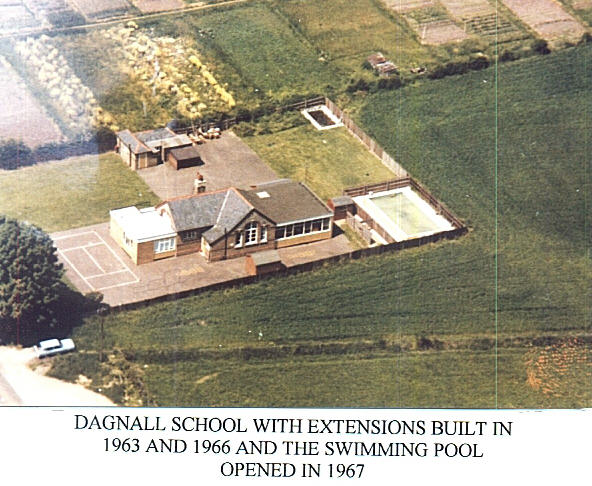
In 1966 an extension was added to the Front of the school to extend the Junior Class Room. In July 1967 the new swimming pool was put into use for the first time and the following year a heater was added. The heater proved a great improvement as it is recorded that on 25th October the pool was used for the last time that year by 3 Infants and 13 Juniors and the Headmistress. The year ended with a Washing trough being installed for the Infants.
In October 1970 the Education Authorities notified the school of the intention to change the status of Dagnall School to a First School in September 1973. An Emergency Managers meeting was called followed by a Public meeting. A protest committee was formed to campaign against the change. One of the reasons for the objection was that the reduced numbers would make the school liable to closure. However in July 1971 a reply was received to the protests from the Dagnall Community from Mrs Thatcher (Secretary of State for Education), to the effect that protests had been overruled and the change would take place.
In February 1972 the seven children in the top year took the final paper in the 11 plus examination. This was the last time this examination was held in Dagnall School as the following year Bucks County Council changed the 11 plus to l2 plus and by 1974 all the older children had been transferred to Edlesborough.
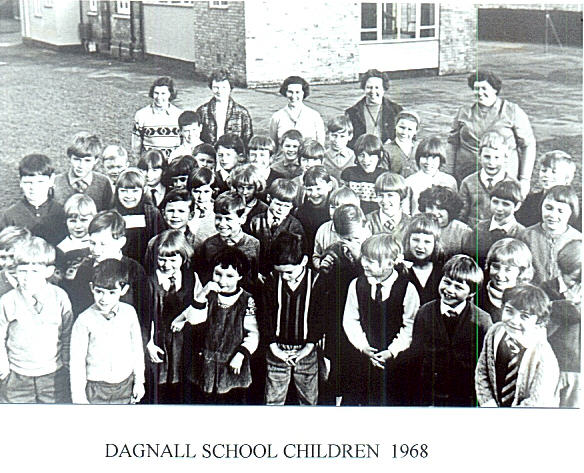
So it was in 1973 that Bucks County Council adopted the three tier system of education incorporating First, Middle (or combined) and Secondary schools. The school leaving age had now been raised to 16 and the age of transfer in Bucks to 12 years. So as Dagnall was to be a First School it would only take children from 5 to 8 plus when they would be transferred to Edlesborough until 12 plus. In September the new year started with 27 on roll, 23 children having been transferred to Edlesborough.
In November 1975 representatives of the County Education Committee visited the school to report on its economic viability as it was one of seventeen small schools in the County under review for closure. However, in March 1976 it was decided the school should remain open. There were now 28 on roll rising to 34 in 1977.
The Education Acts of 1980 and 1986 brought in the beginning of far reaching fundamental changes in the administration of the school. The concept of Local Management of Schools (LMS scheme), meant that every school should have its own governing body, the number being dependent on the size of the school. Dagnall School was to have 3 governors appointed by the Local Education Authority (Mrs Shand Kydd, Chairman, Mrs Square and Mr Spencer), 2 co-opted governors (Mr Stride and Rev Shepherd) and 2 elected parent governors. The headmistress elected not to be on the Governing Board. The governors were to be responsible for the conduct of the school, for the curriculum within the parameters laid down by the LEA and were to share equally with the LEA in the appointment of the Head and Deputies (forming half the selection panel). They also had responsibility for all other staff appointments and for the spending of any funds delegated by the LEA.
By 1988 the number of children on roll had fallen to 13 and so on 18th April 1989 representatives from the schools Provisions Panel visited the school to assess its viability and to advise on the possible closure. This was greeted with some dismay as a large number of small schools in the County had recently been closed. A Save our School action committee was immediately formed within the village to Campaign to keep the school open. It was in June that the school was notified by the Education Authority of a Public Meeting to be held in the Village Hall on Friday 7th July 1989 and be chaired by Mrs Embleton M B E, Chairman of the Schools Provision Panel, to outline the proposals to close the school from 1st September 1990.
At the meeting the main argument put forward for the schools closure, apart from that of its financial viability and a potential saving on money by transferring the children to Edlesborough, and not having to incur the building costs of having to provide the necessary inside toilets, was that small schools were often not able to offer the range of educational opportunities available in large schools. It was also said the school would have difficulty in covering the range of subjects in the new National Curriculum. The 1988 Education Reform Act bad created a National Curriculum to be introduced into all schools from September 1989, consisting of 3 core subjects of English, Maths and Science and a further 7 foundation subjects of History, Geography, Technology, Art, Music and Physical Education, with a national assessment of 5-7 year olds at 7 years of age.
Speakers from the floor put forward counter arguments stressing the educational advantage of small class sizes and small schools, expressing confidence that the school would be fully capable of meeting the parameters of the new National Curriculum, and also stressing the important part a village school plays in the social cohesion of a village, offering a stable environment for the children and encouraging in them a respect for the village and thus the environment in general. Also, the opportunity for developing a strong parent, teacher relationship.
On the 20th July Miss Linnell, Headteacher, retired after 22 years at Dagnall School and Mrs Cook was appointed acting Headteacher.
On the 26th October Bucks County Council issued formal notice that as from 31St August 1990 the council would cease to maintain Dagnall School and as from 1st September the children would be transferred to Edlesborough.
The S 0 S Committee continued its activities and formulated a case against closure of the school. On the 20th December, with the co-operation of the Rt Hon George Walden M P, three members of the committee presented the case for non-closure of the school to the Secretary of State for Education and Science. It was with much jubilation that on 6th April 1990 notification was received that the Secretary of State had overruled the County Council’s proposals, and the school was to remain open. Confidence in the school remaining open having been restored, pupil numbers henceforth steadily increased.
The Education Reform Act of 1988 introduced further far reaching changes to the administration of schools and considerably increased the responsibilities of school governors. These changes were gradually implemented during the early I 990s, starting with the senior schools.
The honorary school governors were to be responsible for determining the staffing complement of the school, both as to numbers and gradings. They alone to select the head and deputy (the Chief Education Officer having a right to be present as an advisor but not to vote). They were also to be responsible for all staff appointments and assume all the personnel functions, including pay enhancements, discipline and grievance procedures and dismissal. All the schools were to have delegated budgets based largely on pupil numbers, hence creating an emphasis on increasing the number of pupils in a school. The number of children on roll thus becoming a vital factor in a schools viability.
In 1996 Bucks C C agreed to install inside toilets during the 1997/1998 works programme. Dagnall School by then being the only school in the County with outside toilets and the number of children on roll having risen to 29 from the 13 in 1988.
1996 was quite an eventful year. Mrs Cook was retiring after 7 years at Dagnall School, so the School Governors invited candidates to apply for the forthcoming Headteacher vacancy. Interviews took place on 17th May and Mrs J Lambert was appointed the new Head.
Central Government introduced a new initiative for the expansion of under 5 education. So Dagnall School arranged to admit 4 year olds for five mornings per week as from the following year.
Bucks County Council announced a change of policy as to the age of transfer. The 12 plus examination was to revert back to 11 plus and children would transfer from primary to secondary schools at 11 plus. In conjunction with this the age of transfer from First to Middle school to be changed from 8 plus to 7 plus.
1997 saw the demise of the school swimming pool. It had become structurally unsafe, and the cost of repair together with quite major alterations to meet the changed safety standards, was more than the school could afford. In addition swimming was no longer on the curriculum for first Schools so it was decided to demolish the pool and use the site for an educational play area for the 4 year olds. The pool was demolished in September 1997 at the same time as work began on another small extension to the school. This was to provide the indoor toilets for the children, together with an office to cope with the ever increasing administrative work, and a staff room.
The School Act of 1992 established OFSTED (the Office of Standards in Education), whose function was to organise regular inspections of schools. Inspection of schools was therefore privatised and anyone could apply to become an Inspector, although in practice the applicants were mainly from the now redundant local authority inspectors and retired school teachers. OFSTED was to invite tenders from the newly created inspection teams and choose one for each inspection.
Dagnall School had its first inspection in February 1998. The inspection team sat in on lessons and perused the children’s written work and educational records and reports. They inspected the administration records to check the school was complying with all the statutory requirements and was being efficiently and effectively managed. They also conducted interviews with the teaching staff and school governors and met the parents.
A very detailed report was published the following month which in essence concluded that the school provided a good quality of education representing good value for money. "Basic skills in English are particularly good, Pupils are secure in numeracy skills and reach high standards in mathematical investigations and science. The school sets a good working atmosphere and is successful in providing an ethos in which honesty, fairness and respect for other people and their property flourishes. In addition the school is well managed."
1999 saw the introduction of the age of transfer change in Aylesbury Vale. As from September, Dagnall School was to take children from age 4 to 7 plus instead of 4 to 8 plus
So Dagnall School was to enter the new Millenium with a new challenge in its chequered history, but was confidently looking forward to celebrating its centenary in 2009.