RAF EDLESBOROUGH - A Significant Role in WW2
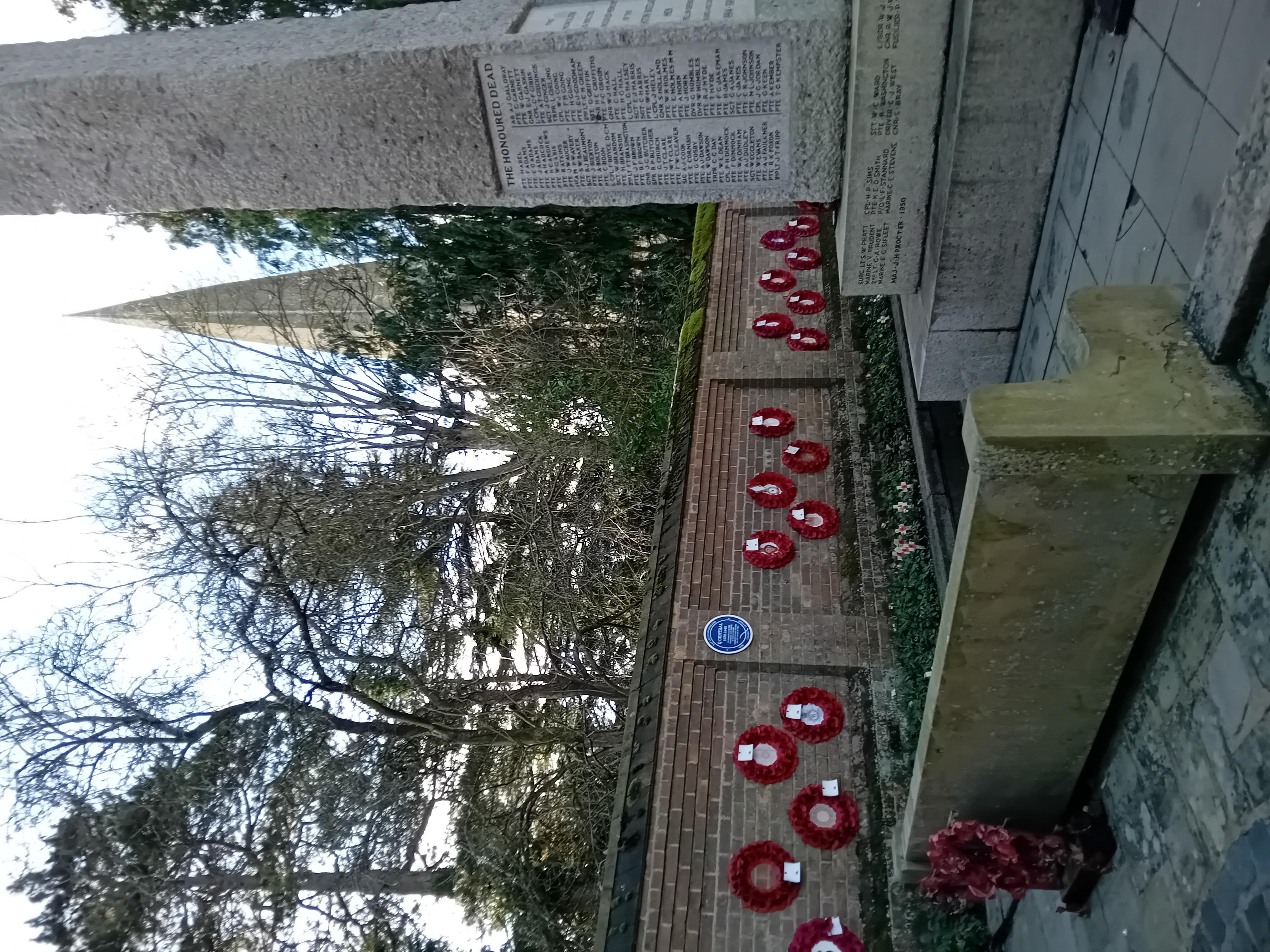
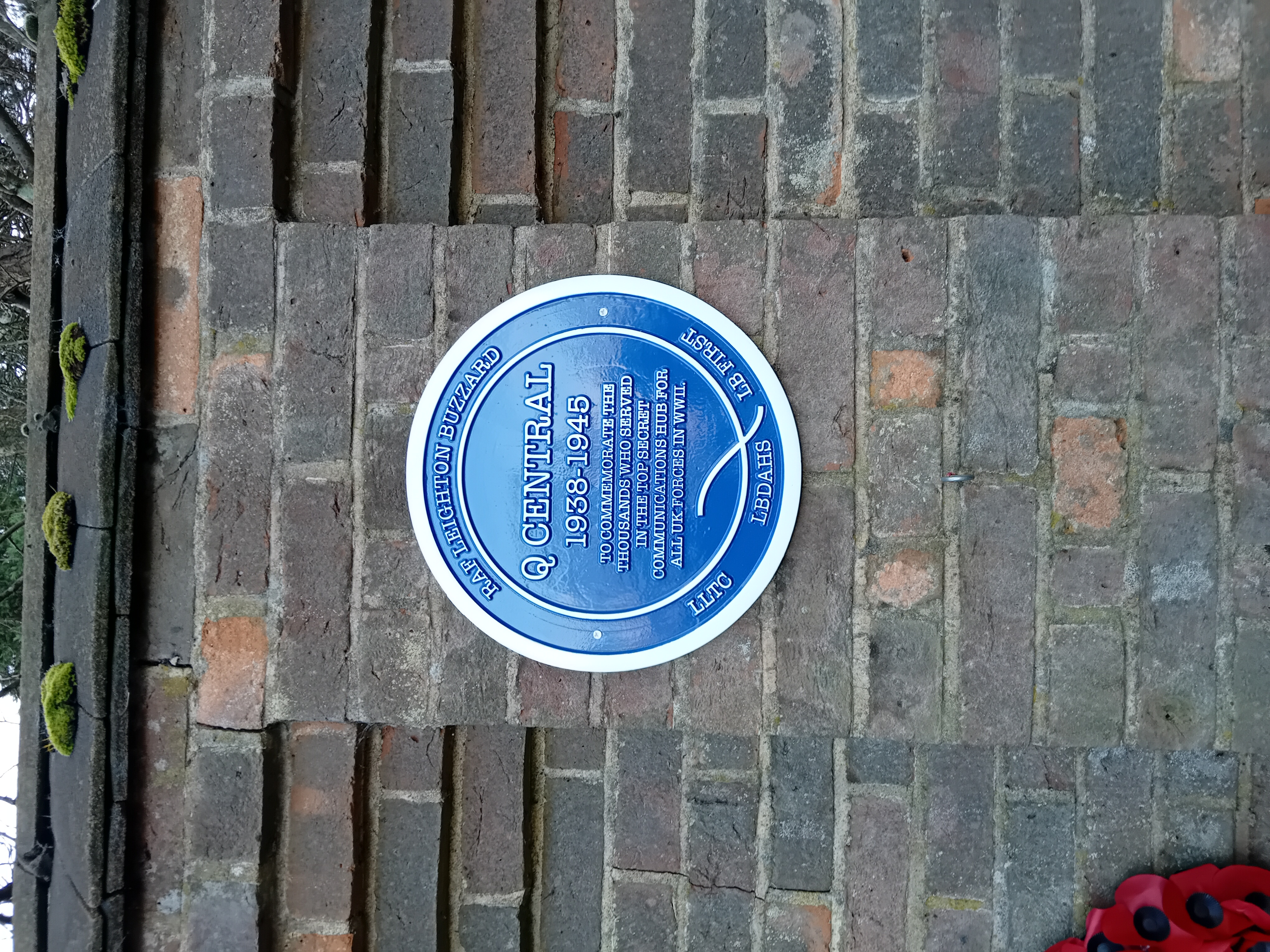
A blue wall plaque to commemorate Q Central was installed close to the War Memorial in Leighton Buzzard on 11th November 2025.
Created by Friends of the Church on the Hill for a Heritage Open Days Display at St. Mary's Church
RAF EDLESBOROUGH - A SIGNIFICANT ROLE IN WW2
RAF Edlesborough was one important element of a network of intelligence and communications located in this area during World War 2 that made a major contribution to the successful outcome of the conflict.
Formerly RAF Dagnall, RAF Edlesborough was a satellite station to RAF Stanbridge, formerly RAF Leighton Buzzard known during the war by its code name Q Central, which was the nerve centre for the nations war-time communications, using systems at the forefront of technology at the time. At its peak Q Central had a staff compliment of over one thousand service personnel receiving intelligence and information from Bletchley Park (known most notably for its code breaking), the Met Office (relocated out Of London to Dunstable) and receiving stations at RAF Chicksands (Beds) and others.
Outbound communications were via two main transmitting stations, one being RAF Edlesborough and the other at Greatworth (Northamptonshire). Leighton Buzzard was itself was one of the receiver sites, the other being at Bampton Castle (Oxfordshire). Receivers and transmitters could not be located too close together for technical reasons, and all key facilities were duplicated for security of the service.
Very little was known about the extent and importance of activities in the area, particularly those at Leighton Buzzard until relatively recently when Official Secrets Act restrictions were lifted and documents released. The story of Q Central has been summarised by Paul Brown and Edwin Herbert in their book, first published in 2014, 'The Secrets of Q Central — How Leighton Buzzard shortened the Second World War'. Much of the information reproduced here has been taken from this book.
Although Germany was aware of the aerial site at Leighton Buzzard (photographs from their reconnaissance aircraft show it clearly) it must be assumed that they never worked out the true nature of this site and the work being done there, otherwise a very different story would be told.
Q CENTRAL - RAF LEIGHTON BUZZARD
The site, located 1.6 miles west of Stanbridge village, was chosen because it had good wireless reception and was close to the existing General post Office (GPO) trunk telephone network, and importantly had otherwise no military significance. The GPO was the postal system and telecommunications carrier of the UK until 1969.
Q Central was created as the main Central Exchange and Wireless Telegraph Station for the RAF's telegraph and telephone network in 1936 and became fully operational in 1939 with 600 service personnel.
During WW2 it was used as the base for Secret communications traffic, handling practically all of the national landline teleprinter communications and a large part of the private speech telephone system, together with wireless transmission and reception of all RAF international communications.
It was described in 1942 as being 'the largest telephone exchange in the world.’
All sensitive equipment and operations were housed underground. An account by a gunner from a Lancaster bomber who was posted to defend the site, said they were armed with twin Lewis guns, but instructed not to use these in case it drew attention to the site. The 'weapon' installed to defend the site was a ring of boxes around the base that would discharge large parachutes into the air to deter low flying aircraft. These never had to be deployed and their effectiveness never tested!
The site was located adjacent to a manufacturing facility for Marley tiles. The excavations at the site were suited to the formation of an extensive underground tunnel network used to accommodate equipment and operating staff. The factory building was converted to barracks for service personnel, but was lacking in the most basic comfort provisions.
Originally used as a receiving station for international RAF radio signals, it became the secret communications hub for army, navy and RAF units as well as MI5, M16 and M18, all using its teleprinters and cyphers. RAF Fighter Command and Bomber Command depended on its signals to direct operations.
The site extended over 100 acres (44 hectares), having eleven 90 feet high radio masts; supplemented by a further 27 masts later. However, the other important part of the of the site was that relating to its other function, and this was heavily camouflaged with the colour changed regularly to suit the seasonal change in the surrounding landscape.
By 1941 Q Central was responsible for remote sites including 'Dagnall' ( RAF Edlesborough), the Met Office 'Dunstable', and the airship base at Cardington.
At its peak the communications network comprised over 1200 telegraph circuits, 562 terminal stations and 10,000 teleprinters. Early in 1940 Q Central handled 3000 telephone messages daily, rising to 5000 messages plus 30,000 teletype calls by 1944; one year later the number of telephone messages being printed rose to 10,000 daily.
Q Central had a number of operating sections —
- Continuous wireless contact with the Middle East. Far East, Australia, New Zealand and Canada.
- Central telephone exchange with all Air Ministry Admiralty, the War Office and eventually all theatres of war.
- Central Defence Teleprinter Network for communication with Military HQ's, the Met Office,
- Signals Intelligence at Chicksands and for MI5, M16 and others.
- Multiple teleprinter switchboards (the first of its type) one for Bletchley park and others for the intelligence Services.
- Transit control
- GPO engineering.
In summary, it had hundreds of teleprinters connecting the base to every theatre of war. All vital military landlines were routed through the base, and it was the centre for all wireless communications for armed forces, facilitated by the transmitters at RAF Edlesborough.
It is of particular interest to note the other intelligence and military locations in the area —
- Bletchley park — the facility for deciphering, including enemy codes intercepted at Q Central.
- Milton Bryan had the black propaganda studios
- Woburn Abbey housed the political warfare executive
- The Met Office 'Dunstable'
- Oxendon House, Plantation Road, Leighton Buzzard housed RAF No 60 Signals Group Fighter
- Command, being the Centre for RADAR operations for the Battle Of Britain, the D-Day landings and other campaigns around the world.
- RAF Chicksands signals intelligence unit
- Airfields at Wing (a bomber training base), Cheddington, Little Horwood and a grass strip at the Woburn Estate.
- Leighton Buzzard Corn Exchange had hundreds of teleprinters in use up to 1943.
- Fighter Command at Bentley Priory, Stanmore
After the War RAF Leighton Buzzard (Q Central) was renamed RAF Stanbridge. It continued as the hub of the RAF communications network. In 1359, as the Central Signals Centre, it was handling 10,000 messages a day, both national (5500) and international (4500). It later became designated the Control Centre at heart of the Defence Communications Network, established in 1969.
By the early 1970s the RAF satellite sites receiver stations were at Stoke Hammond and Bampton Castle linked with Brize Norton), and transmitter sites at Edlesborough, Weyhill and Greatworth; communicating as far afield as Canberra, Cyprus, Ottawa and Malta.
In the mid 1980s equipment at RAF Stanbridge was obsolete and in 1987 its role was in logistics management for the RAF, until its closure in 2013, when declared surplus to military requirements by the MoD. The site was sold to property developers and all station buildings demolished.
THE MET OFFICE
In 1938 plans were made in the event of war to move the Central Forecasting Unit from Kingsway in London to a provincial location.
Dunstable was chosen because it was convenient to GPO land lines, not too far from London (with two good rail links close by via Luton and Leighton Buzzard, and close to the RAF Communications Centre at Leighton Buzzard, and to Bletchley Park (sometimes referred to as Station X). Also, wireless reception was good in the area as was housing for personnel in the nearby town.
The move was made to a site located to the west of the town off Drovers Way in February 1940, with a code name ETA, but it was usually referred to simply as 'Dunstable'.
It was surrounded by high chain-link fencing topped with barbed wire and protected day and night by civilian and military police. A camouflaged netting covered the roof, apparently not very convincingly.
Its role was to collect weather data from European and national stations and forecast future weather patterns. This was not an easy task involving difficult and laborious manual calculations and hand drawings before the arrival of computers and satellites commonplace today. An additional task at 'Dunstable', by a specialist unit known as IDA, was to decode Russian and German weather reports, to relieve cryptography staff at Bletchley Park of this task. Close liaison with Bletchley park enabled effective flow of de-coded information to RAF Commands at home and overseas.
Data communication between Bletchley Park, 'Dunstable', London and Q Central was by telex and dispatch riders.
An alternative Met Office station was constructed at Monks Risborough, for use in the event of an attack on 'Dunstable', but was never needed.
(Reference extracts have been taken from the publication 'The Meteorological Office Dunstable and the IDA Unit in WW2' by Brian Audric)
RAF EDLESBOROUGH
Prior to 1939 there was a station in Dunstable, however limitations at this site led to a more suitable site being established at the junction of the Leighton Road and Tring Road (diagonally opposite to 'The Travellers Rest, which was then called ‘Dagnall’.
Experience from earlier overseas campaigns was that operational messages took up to 5 days to reach their intended destination, highlighting the need for high speed (high frequency) transmission.
Approval was given for works to proceed in April 1938, which included a total of 18 masts and powerful amplifiers to boost the signal to give clear reception abroad. Additional amplifiers were installed in 1944.
The aerial farm in total had an area of the order greater than 35O acres (150 hectares) and comprised 6 masts of 120 feet, 7 at 180 feet and 5 at 230 feet (the masts at Leighton Buzzard were 90 feet).
Little detailed information about the operations at the site has been published to this day, perhaps due to the sensitive nature of its work.
Control of the 'Dagnall' transmitters was from the RAF Leighton Buzzard control centre with the primary function during the war to serve Bomber Command HQ and coastal command sites. A second transmitter station was at Greatworth, Northamptonshire) and together these remained the two main transmitter stations for the long-term. Communication between Leighton Buzzard and the transmitter stations was via GPO control lines.
The site was renamed RAF Edlesborough in 1945 at the end of WW2.
The station was expanded as shown in an extract from Flight magazine, Nov 1959, which reads 'RAF Edlesborough…. its aerial farm implies its function as one of the two main wireless transmitting stations in this country on the Commonwealth Air Forces Network. It has circuits to Cyprus, Ceylon, Malta, Ottawa, and Aden. It was established just before the war and its equipment is used to produce multi-channel radio-teleprinter transmissions in the high frequency band. A continuous watch is kept and the majority of its staff are technicians, for the most part ground wireless fitters….. its longest direct link is 5000 miles with Ceylon. Edlesborough’s title is No 810 Signals Unit. There are 27 transmitters, 15 in constant use'.
In 1982, when run by the Defence Communications Services agency, RAF Edlesborough was up-graded again, at short notice, for use in the Falklands War. It is said by then to have 40 operational high power, high frequency transmitters maintaining 24/7 capability. A further re-fit was made in 1984.
It had a simple cruciform shape building, with a thick concrete roof, containing mainly electrical equipment, a generator block and an administration wing. The staff complement in 1981-83 was twenty engineers and technical staff. The commanding officer had accommodation on the site, and the living quarters for service personnel were along the road towards Dagnall, within walking distance.
The site was occupied until c1997 and closed in 2002, with the masts and electrical equipment removed; the site and building still remains.
ASHRIDGE IN WW2
The Ashridge Estate was used by many regiments for training and preparing for combat, including the Xlth Hussars, 51st Highland Division, American, Dutch and Polish troops.
Evidence still exists of the military activities, such as Barracks Square car park, Monument Drive built by Belgian troops and remains of ground excavations in Thunderdell Wood and near Clinkmere Pond.
Four observation posts were located around the Estate, the main one being at the high point of Berkhamsted Common, used by the Royal Observer Corps to monitor enemy aircraft movements; reporting to the Watford Control Room.
On the south-eastern edge of the Ashridge Estate, between Little Gaddesden and Ringshall, the Deer Leep open-air swimming pool (open c1935-2000) was used by the military for storage.
Ashridge House was an Emergency Medical Services Hospital; opening in September 1939.
Early patients included victims of London bombing raids, which was the intended primary function of the hospital. In total, between 1939 and 1946, 20,000 patients were cared for, and over 12,000 operations carried out. Over time, soldiers, sailors and air crew came from every theatre of war, including Dunkirk casualties.
(Ref: Ashridge in WW2, a National Trust publication)
THE POLITICAL WARFARE EXECUTIVE (PWE)
It was based on the edge of the Woburn Abbey Estate in Milton Bryon. There, Sefton Delmer's remit was to deceive the enemy through counterfeit German newspaper articles and radio shows, known at the time as 'black propaganda'.
In 1944, Muriel Spark, the author, at the age of 26, was recruited to work there as duty secretary in the newsroom. The Prisoner of War accommodation in nearby Woburn was bugged allowing their conversations to be used to embellish the 'fake news' stories of the day generated by the PWE. Muriel Spark used the knowledge she gained from this work to inform her later books of fiction.