History
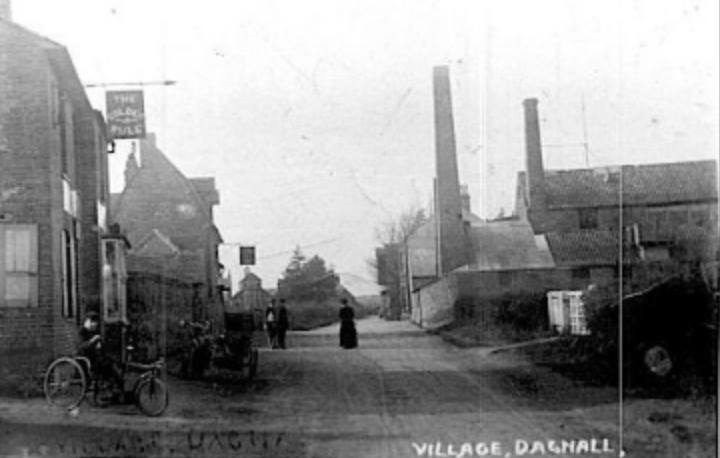
The account below comprises extracts from:
"A History of Dagnall" by Mr Geoff Spencer
DAGNALL
EARLY HISTORY
Dagnall has had a variety of names. In the 12th century it was Daganhalle, in the 13th century Dagehal and by the 15th century Dakenhald.
At the compilation of the Domesday Record it formed part of Eddinberg (Edlesborough) in the Yardley Hundreds now part of the Cottesloe Hundreds.
Prior to the Norman Conquest it formed part of the land held by ULF a theyn of King Edward but in 1086 passed to Gilbert of Ghen (GILBERT DE GAND), a nephew of the Conqueror.
In the 13th century RICHARD SPIGURNELL and NICHOLAS 'SPRIGNEL' are mentioned. By 1297 the land passed to HENRY SPIGURNEL who possessed a house in Dagnall and received a grant of free warren here in 1309.
It appears to have remained in the possession of the Spigurnells until the death of William Spigurnell without issue in 1386. During the 13th and 14th centuries the Manor of Dagnall belonged to the BROCAS family and passing through several hands it came to the LUCY’S who in 1547 sold it to the DORMERS.
By 1664 part at least of Dagnall had passed to JOHN EGERTON, Earl of Bridgewater and from this date descended through the Earls and Dukes of Bridgewater to the 3rd Earl Brownlow who was Lord of the Manor until his death in 1921.
19TH CENTURY
Writing toward the middle of the 19th Century the Reverend W H Kelke has this to say about Dagnall:
"Towards the southern extremity of the parish of Edlesborough and about a mile off the Icknield Way is a large hamlet called Dagnall, containing four or five hundred inhabitants. As seen from the neighbouring eminence, this hamlet has a picturesque and romantic appearance. Farmhouses and cottages, many of them being of early date appear scattered over an undulating well-wooded valley, formed by a circuitous course of the Chiltern Hills. This large hamlet, which is two miles from the Parish Church, has the appearance of a little town containing various shops and a respectable looking inn; yet although it has apparently greatly increased in population it has been deprived of its ancient House of Prayer where formerly daily service was performed and no other has been erected in its stead.
Referring to the old Chapel of Dagnall, the Rev. W H Kelke says "It is not known when this Chapel was demolished. There are no remains of it now existing, nor have any existed, so far as I could learn, within the memory of the oldest inhabitant of the hamlet. Indeed, its site is not exactly known, although its vicinity is included by places still bearing the names of "Chapel Dell", Chapel Lane, and Chapel Wick. "Chapel Dell" which appears to be the remains of an ancient moat, and Chapel Lane form the boundary on two sides of a small croft now occupied by a cottage and orchard. This croft, which is about three roods in extent and contains some irregularities of ground, as if caused by the burned remains of some demolished building, I take to be the site of the ancient Chapel and Chapel yard. Its opposite sides are bounded by a carriage road containing the old stocks, and an open space which may have been a small village green. The bank behind the stocks, although a quarter of a mile from the main part of the present hamlet, still bears the name of the Town Bank. About twenty yards distant from this croft are the remains of the old Manor House, a portion of which is still occupied by cottages. About twenty yards distant on the other side of the croft, is Chapel Wick which may contain five or six acres and is used as allotment gardens, and is probably the land referred to as belonging to the chapel at the time of its suppression.
(Other references refer to Chapel Lane alias Dunstable Way, Town Bank is presumably Pound Bank and of course Chapel Dell is the now dried up village pond.)
The working lives of the people of Dagnall in the 19th Century was dominated by the Ashridge Estate and the Straw Hat Industry of Dunstable and Luton. At the census taken in 1841 there were 75 houses in Dagnall housing 78 families with a total population of 382, the inhabitants principally employed in the straw plait trade.
The Census in 1841 covered the Hamlets of Dagnall and Hudnall including Well Farm and cottages at or near Pratts Hill including the Quaker Burial Ground and three cottages at the part of the Hamlet known as Colliers and two cottages in St. Margarets Lane and a farm homestead and cottages in the parish of Edlesborough at Ringshall.
At this time the majority of the land together with the farms and some twenty cottages formed part of the Ashridge Estate. The farms were rented by tenant farmers and the agricultural labourers worked either on the farms or on the Ashridge Estate.
LATE 19TH CENTURY
In the 1884 an Act was passed giving the vote to male householders in the counties (male town dwellers having had it under an earlier act). And in 1894 a further Act established Parish Councils based on direct elections by the residents. The following year a Poll was taken to elect members to form a Council for the Parish of Edlesborough
Those elected to from the first Parish Council were:
CHARLES ROGERS FARMER & DEALER 91 votes
AMOS GRAY PLAIT MERCHANT 87
MICHAEL SMITH LABOURER 85
WILLIAM HARRIS CARPENTER 77
JESSE GADSDEN FARMER 74
GEORGE HORN FARMER 68
JOSEPH PRATT FARMER 65
FRED BIRD FARMER 60
AMOS SEAR FARMER 56
Those not elected were:
REV. GEORGE BROOKS VICAR 49
BENJAMIN MEAD FARMER 46
MARK SHARRATT FARMER 44
JAMES SAUNDERS SHOE MAKER 35
WILLIAM TWIDELL FARMER 26
Some other candidates did not get any votes.
In the early years of the Parish Council the duties of the Overseer of the Poor and the distribution of various charities were frequent topics for discussion.
Around the turn of the century, Dagnall was still a comparatively isolated village. The majority of the villagers worked within the vicinity of the village, either on the land or within their own homes.
The roads were little more than cart tracks which meant in winter the village became even more isolated as these extracts from the school log indicate:
"Owing to the winter coming on two children who live at Whipsnade and one who lives at Wards have been withdrawn from school for the Winter."
"Owing to the severe state of the weather the children have been prevented from attending school."
"Attendance is worse than on Monday last, the roads are flooded from side to side."
"Owing to the severe snowstorm today only a few children came to school, the school has therefore closed for the day."
The village was however, more self-contained. In the 1880’s there were quite a number of shops and trades, viz.
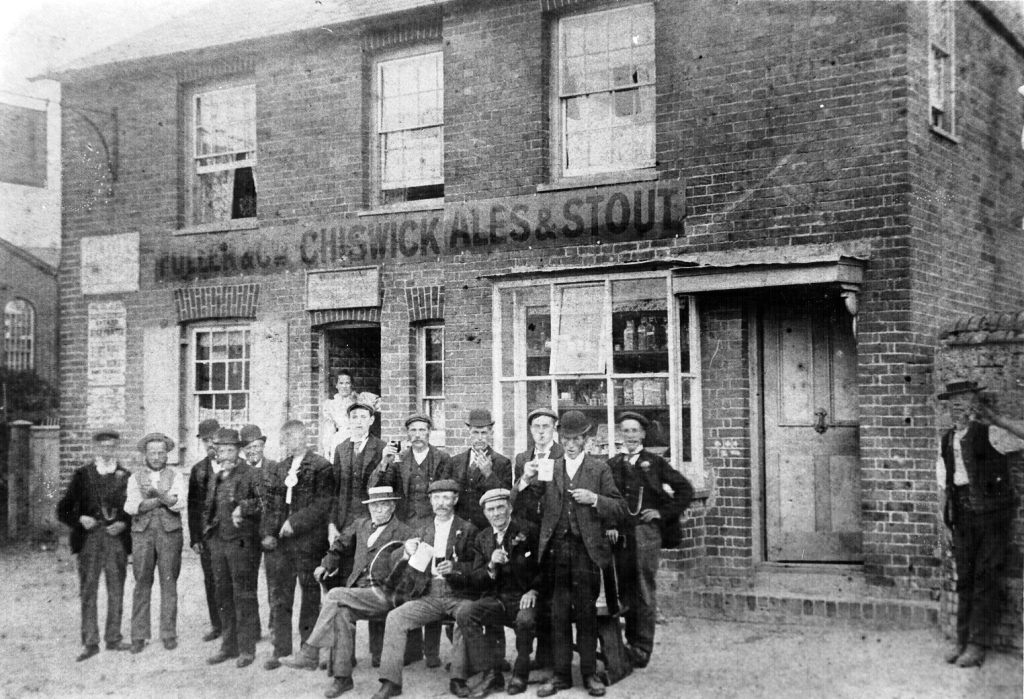
Dagnall Brewery Batchelor Brothers
Red Lion William Chamberlain
Cross Keys William Twidell
Golden Rule John Cox, Grocer and Publican
The Bell David Whitman
Grocers Shop Arthur Jones
Bakers Gadsden Family
Bakers David Holmes
General Shop Charles and Eliza Astling
and Plait Dealer
Shoe and Boot Makers Henry Dean and Henry Rogers
Wheelwright James Munn
Blacksmith James Jones
Carpenter William Dean
Dress Makers Anne Elingham, Sarah Pratt, Annie Dean
Milk was collected from the farms and meat was delivered by the Butchers from adjacent villages.
The village plaiting school had now ceased to function. Those still wishing to learn had to go to the plait school in Edlesborough. The cottage industry of straw plaiting was now a dying trade, although being continued by some of the older villagers.
William Twidell was something of a local businessman. He was involved in the Carrier trade, known locally as Going the Road. This was regular traffic of horse drawn wagons along Hempstead road up to London carrying hay and straw for the stables. The following day they would return with horse manure from the London Mews. Twidell also had a trade in supplying galvanised water tanks which his carter brought back from London. There being no mains water supply, rainwater was collected from the roofs to augment that which was collected from the wells.
In addition to the Public Houses in Hempstead Road there was also THE BELL (now Bethshan) run by DAVID WHITMAN. This was at Pound Bank. There were 32 cottages in this part of the village. At Pound Bank, along Studham Lane and at the beginning of Whipsnade Road and Whipsnade Lane. Whipsnade Lane was known locally as Lucy’s Lane, LUCY MAUNDERS living here with her brother TOMMY MAUNDERS in a pretty thatched cottage called THE ROBBIN HOOD at the beginning of the lane.
Whipsnade Road and Lucy’s Lane curved round Dagnall Hill and Holly Frindle to the village of Whipsnade. This was common land and a very picturesque part of the village, abundant with wild flowers and shrubs. Alas, it was all cleared with the coming of the Zoo.
Between the Malting Lane cottages and Studham Lane Cottages was an area of open fields, an orchard and a house associated with the kennels. The North Bucks Harriers having moved to Dagnall in 1877.
The Dagnall Branch of the Good Intent Lodge of the Manchester Unity of Odd Fellows was a thriving lodge not only of Dagnall workers but also of those from surrounding villages. It held regular meetings and provided sick pay to its members when they were off work.
The Secretary James Jones was known locally as Sunset Jones. One of the rules of the club was that if you were drawing sick pay you had to be indoors after sunset. Jones was a stickler for the rules, so any member drawing sick pay and visiting one of the pubs in the evening with his mates, had to keep a good lookout for Sunset Jones.
Only those in regular work however could afford to belong to sick clubs. The uninsured had to rely for treatment under the Poor Law.
The old Poor Law Act laid down that each Parish was responsible for the maintenance of its own poor. Overseers of the Poor were to be nominated annually and a Poor Rate levied upon the inhabitants. In 1834 the labour-rate system was introduced whereby farmers must either employ out-of-work labourers on their land or help pay towards their upkeep.
Parish Relief, however was not easy to get and apparently was looked upon as a last resort. The village was largely self-sufficient and most villagers had family connections with other members of the village. So in times of hardship they tended to help each other.
THE 1930's
Between the wars there was an acute shortage of housing cheap enough for families on low incomes to rent or buy and the Government introduced various schemes of subsidies to local councils to build houses to fill the need.
In 1930 the Parish minutes record: The question of providing new houses in the Parish for the working classes was discussed - application for six in Dagnall, six in Edlesborough and four in Northall. Later the minutes record that: Application be made to W.R.D.C. for the erection of eight more houses for the working classes of Edlesborough at a site near the Green and four more at Dagnall.
In 1931 the first eight Council Houses were built in the village sited in Dunstable Road adjacent to the pond. Cottage tenants of Pound Bank and Studham Lane were offered these Council Houses at 5/- per week. Many of their cottages were in very poor condition. Some of those at Pound Bank had been built around 1850, had earth floors, no damp courses and were very cold and damp. They were of the two up and two down variety (i.e. a living room and scullery downstairs and two bedrooms upstairs, with a shared outside toilet). Baths were taken in a tin bath in front of the living room fire, the bath being filled by boiling kettles. One lady recalls with due modesty that during her married life in the cottages she always kept her vest on while having a bath. The 15 cottages at Pound Bank were pulled down in 1959. In the intervening years some of the vacant cottages were let to people from London at 3/-to 3/6 per week as holiday homes and weekend cottages. One lady recalls her parents using a Studham Lane cottage as a regular holiday home. Before returning to Brixton the mattresses were brought downstairs and stood against the wall of the room so that the fire next door would keep them aired.
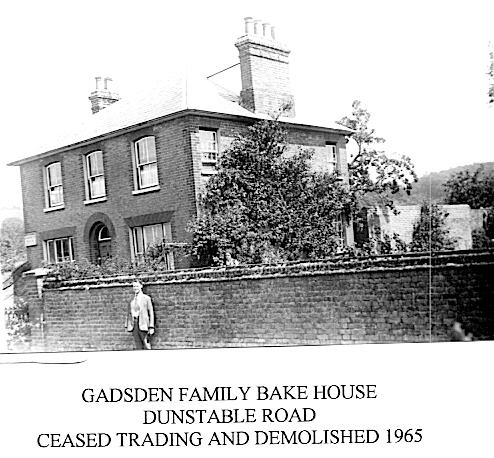
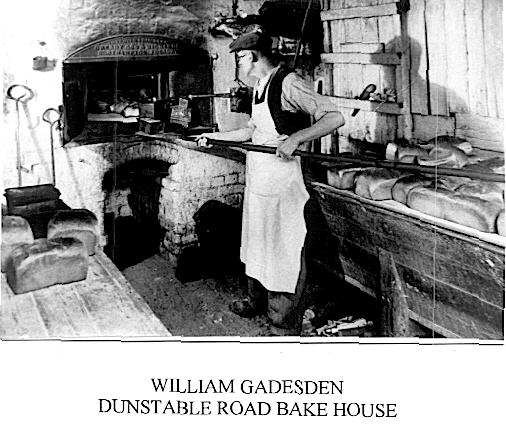
One much appreciated feature of the Council Houses was that they were all equipped with a coal fired kitchen range. Electricity had not yet come to the village and the cooking arrangement in the cottages was an oven at the side of the open fire in the living room. Kettles were boiled on the open fire or on a paraffin stove. Most of the cottagers used to take their pies and cakes and sometimes their Sunday dinner down to the Bakehouse for Mr Gaddesden to put in the oven after the bread had come out. The kitchen range with its oven and hot plates was a terrific boon. The houses were however still lacking a bathroom or flush toilets as piped water and main sewer was still not available. The sculleries were equipped with a brick built copper for clothes washing and at the middle of the row of houses adjacent to the road was a hand pump. This again was an improvement, it being much easier than winding buckets of water up from the wells. A further four Council Houses were built in 1937.

In the 1920’s the Zoological Society of London decided to open a Zoological Park at Whipsnade for the purpose of breeding and exhibition of wild animals, and a sanctuary for British Wild birds and British Wild plants.
A Parish Council minute of February 9th, 1927 records: "Letter and Plan received from Messrs Taylor and Humbert, 4 Fields Court, Grays Inn, London. Solicitors for the Zoological Society for the purchase of Whipsnade Hall Farm were laid before the meeting respecting public footpaths and rights of way between Dagnall and Whipsnade. A lengthy discussion ensued and nothing further was done in the matter."
Presumably as a condition to allow the closing of the footpaths the Zoo purchased by deed dated 1st November, 1928, 1.21 acres of land and dedicated it as a right of way.
During this 20’s and 30’s period other changes gradually took place. The roads which up to now had been little better than cart tracks were progressively surfaced. Public Transport came to the village and by the 1930’s a bus was running through the village every two hours between Dunstable and Berkhamsted. A few villagers were now travelling to Dunstable to work and a number of the ladies were working at the laundry at Ringshall.
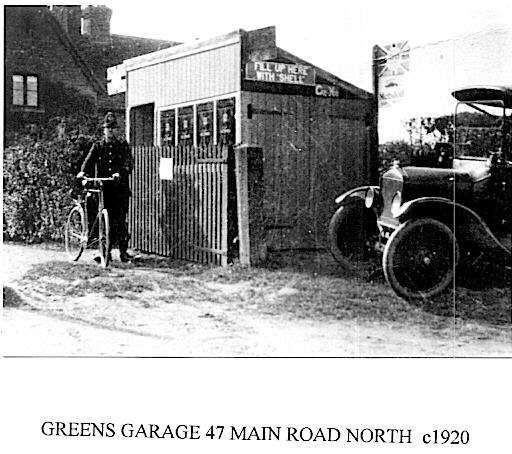
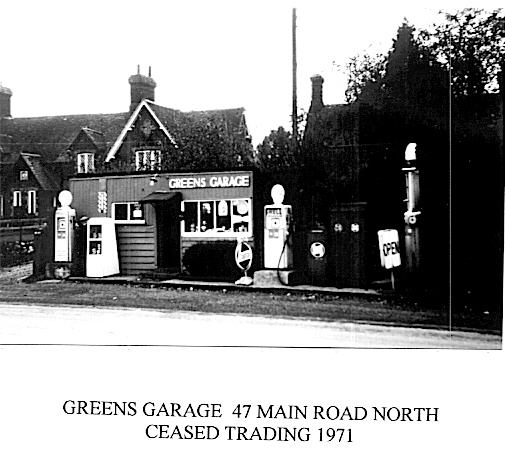
In 1925 the Wheelwrights closed and in 1928 the old Dagnall Brewery Chimneys were pulled down.
The Bakehouse at the crossroads run by the Holmes also closed. The village football and cricket teams had been playing on the field next to the school but with the opening of the Village Hall they were given the use of the adjacent field. The V.H. minutes in 1936 record: "It was agreed that the football club should be allowed to have the scullery for club usage and also permission was given to them to erect a stile leading from the hall grounds into the playing field."
With the opening of the hall more entertainment was possible. Dance Bands were regularly being booked by the V.H. Entertainment Committee and occasional bookings of concert parties from Dunstable and Studham. An increasing number of clubs were in being. By 1938 there were representatives on the V.H. Committee from the:
Women's Institute
Men's Guild
Oddfellows Club
British Legion
Football Club
Methodist Church
Steam Wagons were in their heyday with Chapel Dell Pond, which took the rain water coming off the hill and down Studham Lane, being used to replenish their water supply. It was also used of course, as were the other ponds in the village for watering the horses.
In 1935 Electricity came to the village and the houses and farms gradually had electric lights installed. One age old custom at the Golden Rule also came to an end. It was usual at the end of an evening of Darts for each player to have five darts with which to attempt to extinguish the candle that lit the Dart Board.
On 7/11/38 the V.H. Minutes record that damage had been done to the privet hedge in front of the Hall by ‘Press and Son’ who were laying water pipes along the road. It was in 1940 that water started to be supplied to the houses. Some people had it taken to a tap in the scullery whilst others had a standpipe outside the back door. It was laid on to a tap in the scullery of the village hall in November, 1940.
A matter of some concern to the Village Hall Committee in 1938 was what should be done in the event of a fire in the hall. After investigation it was reported that the Parish Council had arranged with the Captain of the Luton Fire Brigade to serve the district if called upon. But as no premium had been paid to them it was doubtful if they would come. The matter was apparently left unresolved.
The V.H. Entertainment Committee continued to be active in arranging classes, concerts, sausage and mash suppers etc. culminating in August Bank Holiday Monday at Collyers as usual but now with Mr and Mrs Cory in residence.
On 6th September 1939 the minutes record "It was decided that owing to the outbreak of war no Clubs or Entertainments should be started in the Hall for the time being."
The first impact on the village at the outbreak of war was the arrival of the evacuees. Mr George Norman was the billeting officer for the village and made the local arrangements as to how many evacuees each family was to have. Some of the evacuees had been holiday visitors and were able to make their own arrangements, going as a family into cottages they rented, or staying with families they knew. The bulk however came from London under the government evacuation scheme.
On 2nd September 1939 the day before war was declared a coach arrived in the village carrying about 25 children. Each child had a few personal belongings, were carrying their gas masks in a cardboard box over their shoulder and wearing round their necks a label with their name L.C.C. number and the address of the school they had come from. The went into the village hall and were then allocated to the families with whom they were to stay.
The children came from varied backgrounds, mostly from well cared for homes, but although unemployment and near poverty had by no means been unknown to many Dagnall villagers they were shocked at the poor condition of many of the children. Some of them arrived in very dirty, lice infested clothing which was promptly burned by the horrified villagers on whom they were billeted. Life in the worst of the slums had not encouraged decent living habits and some of them for instance were not used to eating a meal from a table. In the terribly overcrowded conditions from which they had come they were more used to eating snacks of fish and chips and bread and jam out in the streets.
It must have been quite an educational experience for both the villagers and the evacuees. Some children had come from homes where they were used to internal plumbing, gas cookers and electric light and had to adapt to rural life. Whereas others had to learn cleaner living habits and found they were expected to sit at a table at mealtimes and use a knife and fork. There were many complaints of children running around the fields chasing sheep and cattle and damaging farm implements. Fortunately for the village most of the more disruptive ones gradually drifted back to London during the first year of the war. Perhaps surprisingly most of the evacuees soon adapted to village life and made friends with the village children, so much so that some families never returned to London and are still living in Dagnall or adjacent villages, and a lot of them continued to correspond and visit their hosts for many years after the war.
More formal education for the evacuees was given by Miss Houghton a London school teacher billeted at Cross Keys Farm. There was insufficient room in the village school for all of them so some were taught in the Village Hall.
As the war progressed increasing numbers of the men went into the services. Farming however was a reserved occupation so farmers and farm workers stayed to work the land. Between the wars agriculture had been in the doldrums, but it now became a vital industry and increasing amounts of land were brought into cultivation. To meet the demand for the extra labour needed Agriculture Executive Committees were created to organise the additional workforce. The local one being set up at Wing.
The extra labour was provided by ‘Land Girls’. Young women had to do some form of war service and many thousands elected to join the Women's Land Army. A contingent of them were billeted at Mentmore and transported to farms around the area as required. They came mainly from the cities and the local farmers say how most of them took to farming surprisingly well. In fact a lot of them continued to work on the land after the war instead of going back to the towns and many of them eventually married local men and still live in the district.
Later in the war the agricultural work force was further supplemented by German and Italian Prisoners of War, some of whom were in a camp at the Gliding Club. They mainly worked in groups under the supervision of a soldier, but were also used singly, when they stayed on the farm and were the responsibility of the farmer.
The countryside around the village became increasingly populated. There were troops stationed in Ashridge and Ashridge House became a troop hospital. A section from the R.A.F. Regiment were at the Radio Station and some A.T.S.Girls were stationed on what is now the Golf Course and manned the Searchlight at Hall Farm. There were also some Czechs and Poles in a bomb disposal squad billeted in the village. There was a fair number of bombing raids in the area, the targets presumably being the Radio Masts on the Leighton Road and General Motors Factory at Luton.
The army had two firing ranges nearby, one at Beacon Hill and the other at Incombe Hole. There were Tank manoeuvres around the village and a very large exercise in preparation for D-Day involving thousands of troops and armoured vehicles.
The local menfolk who weren’t in the services were in The Home Guard or were A.R.P. wardens. A three months stock of tinned food was kept in an outbuilding at Cross Keys Farm as an emergency food supply for the village in case of an attempted invasion.
THE POST-WAR YEARS
During the War, as might be expected, the Village Hall had been mainly used for war purposes; School for evacuees, A.R.P. and Home Guard stores and training, and other activities pertaining to the war effort. The Village Hall Management committee meetings were very infrequent. It was in December 1946 that the minutes record that owing to the conditions prevailing during the war years the committee had been unable to maintain the hall in the condition laid down by the rules. A new committee was elected and arrangements made to start on the necessary repairs.
Although electricity had come to the village before the war it was mainly used for lighting. In 1947 a Power Point was fitted in the kitchen and a letter sent to the electricity board to enquire about heating the Hall by electricity and the cost of renting an electric cooker. The cooker and heaters were installed in 1948 and the oil stoves sold.
On 12th September 1945 some of the ladies of the village held a meeting to discuss forming a Dagnall branch of the Women’s Institute. The suggestion was approved and at a meeting on the 20th September the Dagnall W.I. was formed with 32 members and a committee consisting of: Mrs Bell, Mrs Cato, Mrs Dean, Mrs Dormer, Mrs Fehr, Mrs Green, Mrs Harbourn, Mrs Pratt, Mrs Stuart Putman and Mrs Silas Thame.
In 1948 a new Post Office and shop was opened by Mrs Fehr in the house at the crossroads, Normans having closed their shop in Studham Lane the previous year.
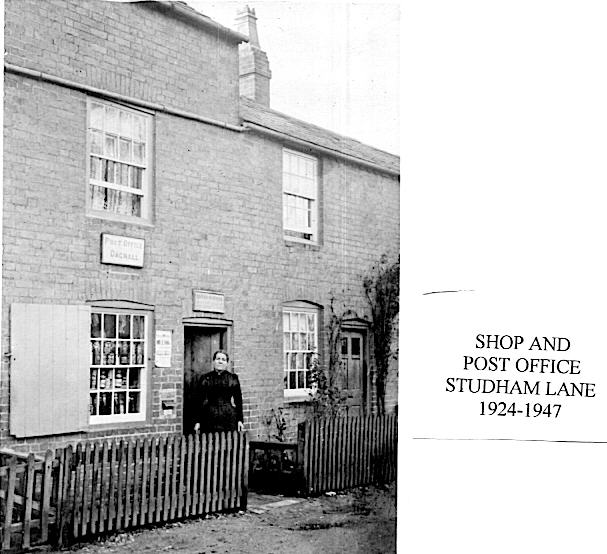
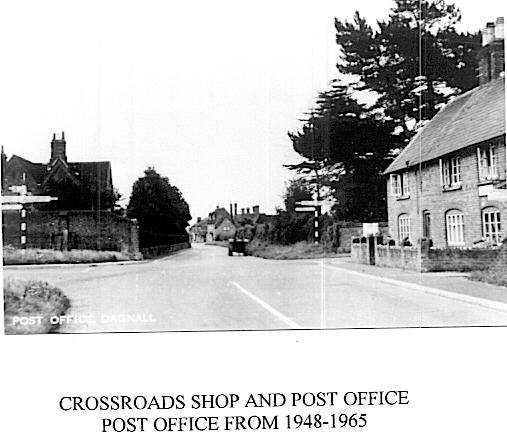
Food rationing was still in force after the war and now bread was included in the rationed items. Parish Council minutes of November 1946 record, "Due to difficulties caused by bread rationing it was agreed that distribution of charity bread to be held over". It wasn’t until 4th January 1950 that the Clerk was instructed to write to Mr Asbby to start distribution again.
The number of loaves distributed on January 30 was 513 at a cost of £21/7/6 and a further 355 in April at a cost of £14/15/10.
The 1950’s brought further changes to the village. A main sewer was laid and the Village Hall minutes in 1956 record flush lavatories being installed and connected to the sewer. It was at this time the Village Hall Management Committee was becoming increasingly concerned at the apathy being shown by the villagers to the Village Hall. Posters were put up in the village headed "How can we stamp out the local scandal?" The scandal, so far as the committee was concerned, was how few people were interested in their village hall.
A general meeting was held on 6th March 1956 at which ten committee members attended. At the meeting Mr Martin Smith, who was in the chair, said he was disappointed that only three villagers had come to the meeting. It was suggested that as there now seemed to be so little interest in the Hall and it was being used so little that it should be closed. The Chairman then proposed the committee should resign en block. The Rev. Jones said he felt the public should be given a final opportunity to show some interest and a pamphlet should be distributed to every household In the village announcing a forthcoming meeting. If there was no response the committee would then seek means of closing the hall either temporarily or permanently and thereafter all resign.
A suitable poster was distributed and at the next public meeting held on 19th March 1956, 35 members of the public were present. A vote was taken and they were unanimous in wanting the hall kept open. A number of volunteers then came forward to organise a Garden Fete and Whist Drive, funds being urgently needed to pay the £200 bill for connecting the hall to the main sewer.
The mid-50’s saw further house building in the village. Twenty nine more council houses were built in Dunstable Road and what was to be called Nelson Road, making a total of 42. The two halves of the village were now joined by houses along the North side of Dunstable Road. Five houses were also built on the South side of the road and Mrs Fehr transferred her shop and Post Office to number 14.
The occupiers of the new houses were in the main, from within the village or from nearby villages. Agricultural employment was steadily decreasing, but with ownership of a motor bike or car becoming more widespread, increasing numbers of the villagers were now working in industry, mainly at Dunstable at the manufacturing firms of Vauxhall Motors, Commer Cars, A.C. Delco and Waterlow Printing.
By the end of the 50’s the population of the village had increased from around 240 at the outbreak of war to about 310.

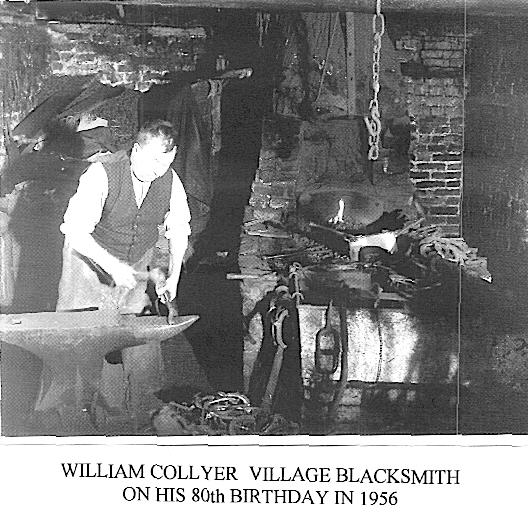
November 1956 had seen the 80th birthday of Mr William Collyer, the village blacksmith. He had been a blacksmith for 62 years, the last 50 years at the forge in Dagnall which was then reputed to be about 250 years old. His range of work as a blacksmith had been steadily declining and he was then only shoeing horses. He finally retired a few years later.
It was also at the end of the 50’s that the fifteen cottages at Pound Bank were pulled down.
Although by this time petrol and diesel engined vehicles were commonplace in the village, horse drawn and steam traction vehicles were still in use.
1965 was the start of further building development in the village. The cottages at the crossroads, the one-time Bakehouse and later Shop and Post Office were demolished as was Gadsdens Bakehouse in Dunstable Road which had ceased trading a few years earlier. Further houses were now built along the south side of Dunstable Road making a continuous housing development on both sides of the road between the main road and Pound Bank. There were now 120 houses in the village and a population of over 400.
Whereas up to the early 60’s all the villagers had been and still were working either in or within a few miles of the village, according to a survey carried out in 1973 by Richard Higgs the newcomers were commuting further afield. Of the occupiers of the thirty houses built in the 60’s, five were retired, seven worked in the village or in Dunstable and eighteen worked further afield in Hemel Hempstead, Watford, Uxbridge and London.
The Wesleyan Chapel which was now 120 years old had become structurally unsafe so in 1967 the Methodist congregation moved into All Saints Chapel of Ease at the crossroads which they henceforth shared with the Anglicans. It was in 1970 the roof collapsed and the Chapel was pulled down.
It was around this time that the shop at the Golden Rule finally ceased trading. The village now had just one shop - Mrs Fehr's shop in Dunstable Road. This shop also closed a few years later in 1976. However, a new shop & PO, Nash Stores was opened by Mrs Nash the following year in 1977 at No. 14 Dunstable Road.
The growth of Dagnall Village has been prohibited by strong planning restraint schemes, lying as it does not only in the Metropolitan Green Belt area, but also in the Chiltern Area of Outstanding Natural Beauty. However in 1975 planning permission was given to build a further 36 houses as infilling between the houses in Main Road South and Studham Lane. These houses were completed in 1979 and formed Deans Meadow, Chestnut Close and Huntsman Close.
The houses in the village now numbered about 165 with a further 20 on the outer fringes. The Electoral Register of Dagnall Ward of Edlesborough Parish at the time showed 185 dwellings and a population of those over 17 years of age of 398.
During the 70’s some new clubs were formed. In 1972 Mrs Iris Pratt and Mrs Ivy Munt formed a club for the over 60s, and in 1975 Mrs Wendy Groom, Sue Cawdell and Elizabeth Morgan-Jones formed a Playgroup for the under five year olds.
In 1976 Mr Basil Thome started a Garden Society which operated from a trading hut on the allotments, and the fortnightly Bingo sessions, started with Basil Thorne as caller in 1969, was still going strong.
These clubs, together with a newly formed Youth Group, Social Club, Dancing Classes and Keep Fit classes brought renewed activity to the Village Hall. There was also increased use of the hall for other social activities, children’s parties and village entertainments.
At the end of the 70’s Dagnall Village consisted of a Church, a School for 5-8 year olds, two Public houses - the Golden Rule and Red Lion - a Village Hall and Recreation Ground, a General Shop and Post Office in Dunstable Road with additional produce - potatoes, eggs and Pork meat - available from Cross Keys and Highbury Farms.
A bus ran from the village to Dunstable twice a week on Wednesdays and Fridays and a Mobile Library visited the village once a fortnight. Milk was delivered every other day and the post was delivered and collected twice a day Monday to Friday and once on Saturday.
The amount of traffic along the Main Road through the village had steadily increased over the years, so in 1980 after many years of campaigning, a roundabout was constructed at the cross roads in the village.
It was in December 1985 that saw the closure of the Village Post Office.

In 1986 Edlesborough Parish Council was informed by Eaton Bray Parish Council that they had proposed to the Boundary Commission that Edlesborough, Northall and the major part of Dagnall to the Parish of Eaton Bray in South Bedfordshire and the remaining portion of Dagnall be transferred to the village of Whipsnade.
Hurried meetings were called in the three villages and lively discussions ensued. Opinions were expressed as to whether Bedfordshire County Council provided better services than Buckinghamshire County Council and parents debated the relative merits of the selective education system provided in Bucks as compared with the comprehensive system in Beds. In the event over 720 private individuals sent proforma letters of objection to the submission from Eaton Bray, as well as 60 who made individual representations.
The Boundary Commission concluded that insufficient case had been made out for such a major change. They recognised however that development had overrun the existing boundary between Edlesborough and Eaton Bray and they therefore proposed that the Boundary between Buckinghamshire and Bedfordshire be tied to the line of the River Ouzel. This resulted in the transfer of approximately 50 properties in Moor End from Eaton Bray to Edlesborough.
In the 90s further improvements were made to the Village Hall. Showers and improved toilet facilities were installed. The building was rewired and the lighting improved and oil fired Central Heating installed.
The Hall was increasingly being used by the village community. A Mother and Toddlers club had been started and a musical entertainment function by the villagers had become a regular event. These Dagnall Amateur Productions, which steadily got more ambitious, usually consisted of a cast of some 30 or so village adults and children. The rehearsals took place during the winter months and were staged in the Village Hall during the February half term school holiday.